

Dedicated to the art and practice of falconry falconers' rights and preserving wild raptor take
Mission Statement
To protect and preserve the art and practice of falconry for future generations and to protect falconers’ rights, we hereby declare ourselves as a non-profit organization known as American Falconry Conservancy established in 2002 – an organization dedicated to the art of hunting with trained raptors. It is also our intention to pursue the broadest liberties possible that are not in conflict with legitimate conservation efforts based upon sound biological and legal reasoning. Citizens have a right to practice falconry within the confines of ecologically and ethically responsible behavior, and it is the intention of AFC to defend this right.
Since its formation in 2002, the American Falconry Conservancy has accomplished a great deal. As of 2016 Through our efforts and the hard work of some Minnesota falconers, the best State in the Union for trapping passage goshawks was opened for non-resident raptor take. Through our efforts, South Dakota – an excellent State in the lower 48 for trapping gyrs – was opened for non-resident raptor take. Through our efforts, Alaska – the best State in the Union for taking gyrs and peregrines – has been opened for non-resident raptor take.
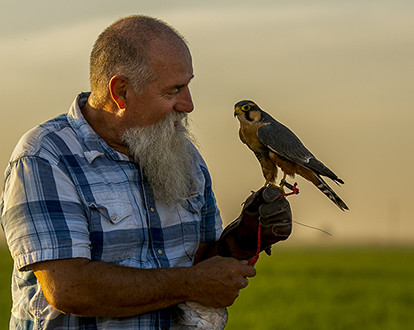
Stop Criminalizing Falconers
Like many Americans, I’m an animal lover who enjoys a deep and caring bond with my pet. But my closest animal relationship isn’t with a dog or a cat, it’s with a 4-year-old aplomado falcon named Ares, which I’ve trained to hunt small game.
Court Case
A civil rights lawsuit has just been filed in the U.S. District Court for the Eastern District of California. This suit seeks to vindicate the Fourth Amendment rights of the named plaintiffs and members of AFC to be free from unreasonable warrantless searches of their private homes, as well as their First Amendment rights to use their birds for expressive purposes for profit if they so choose.

Model Set of State Falconry Regulations
2023 Revision
This model is to be used as a resource for state fish and game departments and falconry clubs when making decisions related to their state falconry regulations. It incorporates Federal requirements but clarifies provisions that were previously unclear. This is important to minimize misunderstanding or misinterpretation of these regulations.

Mexican Raptor Initiative
In 2022, A member of the Mexican Parliament, Deputy José Luis Báez Guerrero of the PAN Parliamentary Group, proposed an Initiative to the Mexican Parliament in which it stated: “The purpose of the initiative is to reform the General Wildlife Law (LGVS), in order to prohibit the use of birds of prey for ornament or as pets.” The intention was to include the ban of raptors for use in falconry as well.
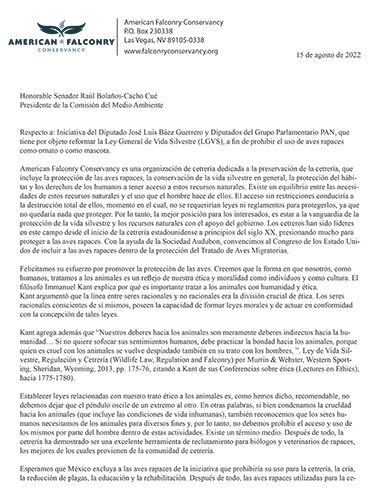
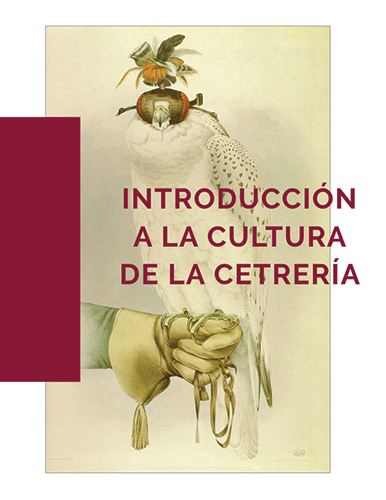
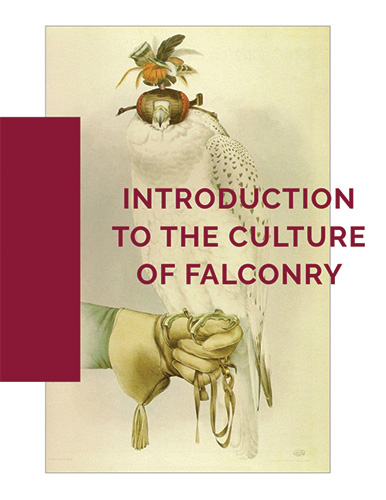
A Mexican member of AFC informed AFC BOD of the situation, which initiated the effort for the Board to inform the Mexican Parliament of the importance of falconry. We composed a letter to their Parliament and then we composed a generic paper titled Introduction to the Culture of Falconry to demonstrate just how important falconry is to raptor preservation and science. This paper was written for all nations to consider when writing laws and regulations related to falconry.
AFC was victorious in our efforts. Because of our work, the Mexican Parliament dropped the Initiative.
Donate
Your dollars make a big difference!